CSS snippets you’ll actually reuse.
These aren’t flashy tricks. They’re practical, time-saving patterns you’ll find yourself using again and again.
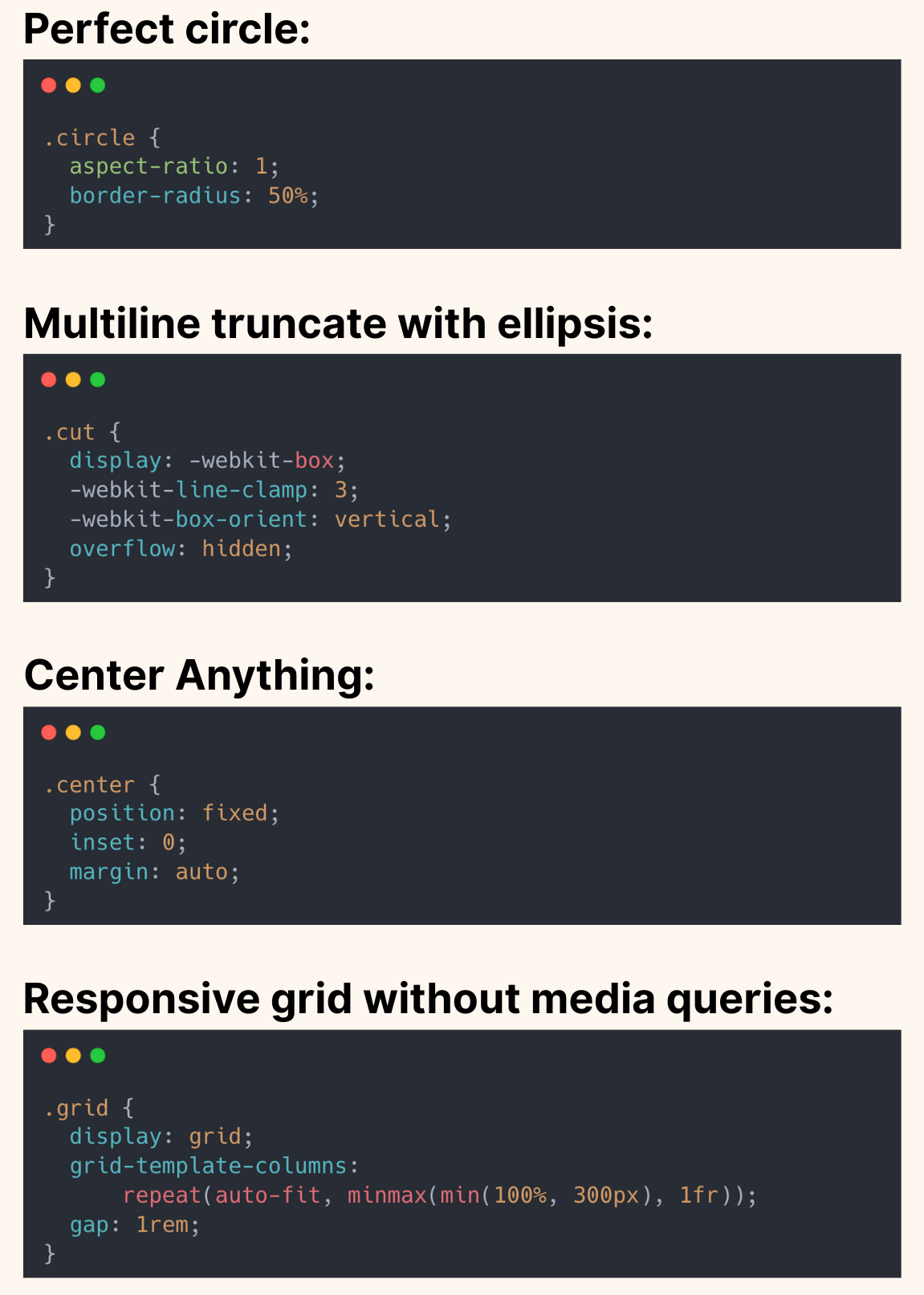
In this image, I’ve shared four essentials:
✅ A perfect circle using aspect-ratio
.circle {
	aspect-ratio: 1;
	border-radius: 50%;
}
✅ A multiline text truncation with ellipsis (no JS required)
.cut {
	display: -webkit-box;
	-webkit-line-clamp: 3;
	-webkit-box-orient: vertical;
	overflow: hidden;
}
✅ A quick way to center anything (yes, literally anything)
.center {
	position: fixed;
	inset: 0;
	margin: auto;
}
✅ A responsive grid layout without media queries
.grid {
	display: grid;
	grid-template-columns: repeat(auto-fill, minmax(min(100%, 300px), 1fr));
}
They’re compact. They work across browsers. And they’re perfect to keep in your snippets library.
Reusable snippets help most when grouped by intent, not by novelty. Organize them around tasks like spacing, truncation, and alignment, so they remain easy to reuse and review across different components.
Reusable snippets deliver most value when grouped by concrete tasks like spacing, truncation, and alignment. That makes them easier to adopt than a random list of isolated tricks.
Validate it with real content and realistic viewport ranges so implementation details hold up outside demos.
To roll this out safely, start by applying reusable snippets in a single UI surface where the benefit is obvious. Then reuse that same pattern in similar contexts so behavior stays consistent and review time stays low.
As a final check, run reusable snippets through edge cases like dense layouts, long labels, and constrained mobile widths.
Keep this pattern documented in your design system notes so future edits preserve the original intent and constraints.
A short internal cheat sheet with “when to use each snippet” helps teammates apply them consistently instead of copy-pasting blindly.
If you liked this tip, you might enjoy the book, which is packed with similar insights to help you build better websites without relying on JavaScript.
Go check it out https://theosoti.com/you-dont-need-js/ and enjoy 20% OFF for a limited time!