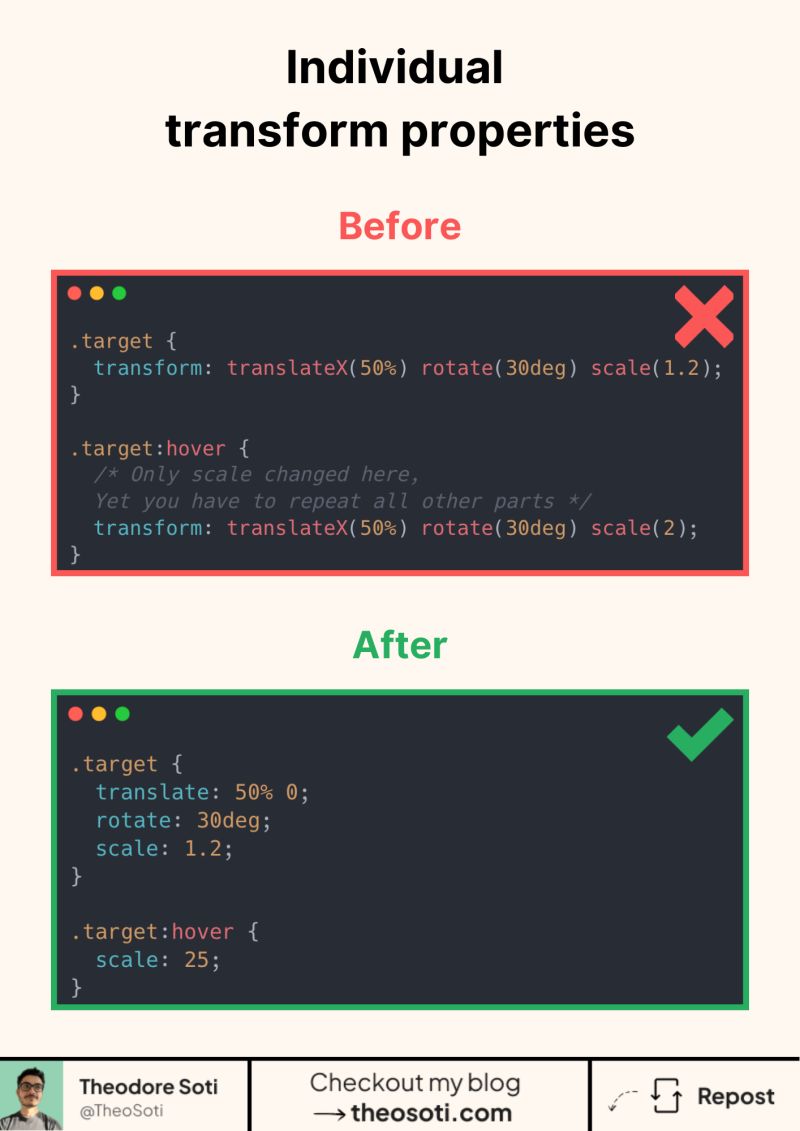
Animations just got easier to manage.
And your CSS just got a whole lot cleaner. For years, combining multiple values in transform meant repeating the full list every time you wanted to change just one. It worked, but it wasn’t ideal.
Now you can split transforms into individual properties:
- translate
- rotate
- scale
No more repetition. No more overrides. Just clean, focused changes.
Why it’s better:
- Each transformation is isolated. You can update one without touching the others.
- It makes animations more readable, modular, and easier to maintain.
- You can now animate them independently at different speeds or stages.
Browser support is solid across all modern browsers. This is one of those tiny syntax upgrades that makes a big difference.
Individual transform properties make motion easier to tune because each axis can be adjusted independently. This keeps animation edits cleaner than repeatedly rewriting long transform value chains.
Individual transform properties make motion tuning cleaner because each axis can be adjusted independently. This avoids repeatedly rewriting long combined transform values.
For production forms, test keyboard order, disabled states, and validation messages with realistic labels. Native behavior should remain intact while visual polish improves.
A practical way to adopt transform is to scope it to one high-impact component first. Then reuse that same pattern in similar contexts so behavior stays consistent and review time stays low.
This is especially helpful during iterative motion tuning because each property can be adjusted without rewriting the whole transform chain.
If you liked this tip, you might enjoy the book, which is packed with similar insights to help you build better websites without relying on JavaScript.
Go check it out https://theosoti.com/you-dont-need-js/ and enjoy 20% OFF for a limited time!